This year’s state budget included welcome news for many districts struggling to conform to the 2022 statewide electric bus mandate: districts will get five more years to figure out the best route forward.
“This is a common-sense adjustment to the timeline, not an abandonment of the goal,” said NYSUT President Melinda Person. “Everyone wants cleaner school transportation and a successful transition to electric buses — but districts need more time and flexibility to do it right.”
In 2022, New York announced all new buses purchased or leased after July 1, 2027, must be zero emission and that every school district in New York must convert their bus fleet to electric no later than July 1, 2035. This year, thanks to NYSUT advocacy, the deadline to purchase zero emission buses was moved to 2032, and the deadline to convert New York bus fleets to electric was moved to 2040.
“The decision to extend the deadline for districts to transition to electric bus fleets is a wise one,” said NYSUT Second Vice President Ron Gross. “We know our members want to help create a more sustainable future for New York, but they need appropriate time and the resources to make this policy a reality.”
“From infrastructure and grid capacity to long rural routes and harsh winter weather, schools deserve a realistic implementation plan that works for every community,” explained Person.
The postponement comes as a relief for many members who still have lots of concerns about how to implement the mandate.
“It was a smart decision,” said Rebekah McMillan, vice president of the Queensbury School Transportation Employees Association, adding, “The grid can't sustain all these school districts in New York state going full electric.”
“My perspective on the mandate is that we're just not there yet,” said Shaun Keturi, day-to-day operations manager for Ithaca City School District’s transportation department and a member of the Ithaca City School District’s Employees Association.
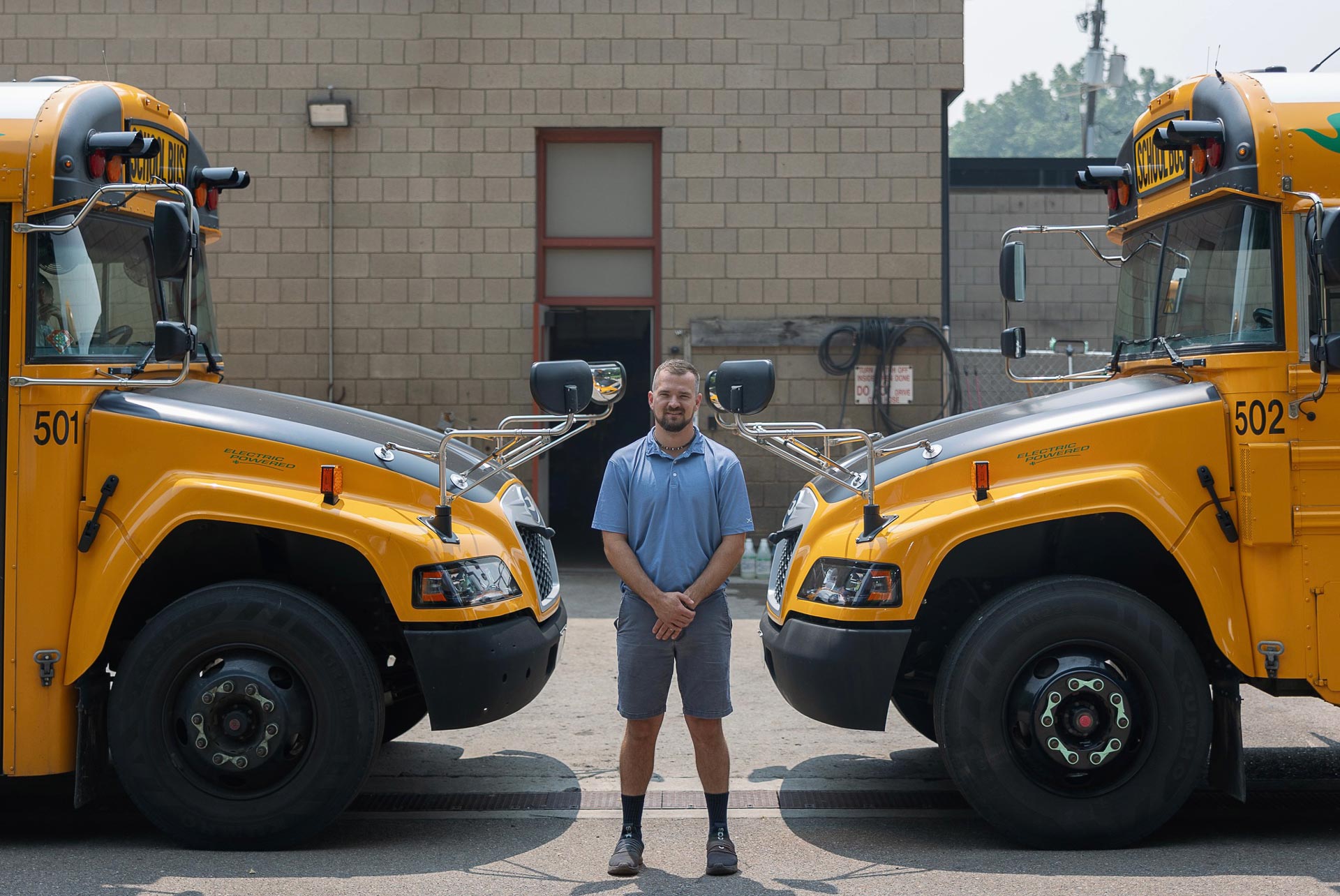 Shaun Keturi, day-to-day operations manager for Ithaca City School District’s transportation department and a member of the Ithaca City School District’s Employees Association, with two of the district’s electric buses. Currently, inadequate power infrastructure in Ithaca has created excessively long charging times for the buses.
Shaun Keturi, day-to-day operations manager for Ithaca City School District’s transportation department and a member of the Ithaca City School District’s Employees Association, with two of the district’s electric buses. Currently, inadequate power infrastructure in Ithaca has created excessively long charging times for the buses.
Shaun Keturi, day-to-day operations manager for Ithaca City School District’s transportation department and a member of the Ithaca City School District’s Employees Association, with two of the district’s electric buses. Currently, inadequate power infrastructure in Ithaca has created excessively long charging times for the buses.
“The charging issue is the biggest thing that we're battling,” said Keturi. “As of right now, we don't have fast chargers, and it doesn't seem like we're going to get anything like that anytime soon.”
Currently the Ithaca district has 100 vehicles in its fleet, seven of which are electric. The district has eight chargers, but they don't get sufficient power, so the electric buses need to be plugged in for 10-14 hours to reach full charge, he said.
“They’re pushing these buses, but I can’t power these buses,” Keturi said. “We’re still years behind.”
Mileage is another factor, and variables like temperature and topography make a big difference for districts.
“In the summer, we get right around 80 miles, on average, but in the winter, that drops down to right around 50,” Keturi said, adding that in his district, buses drive on average 100 miles a day, which means that it’s harder to use electric buses for longer routes, extracurricular or athletic activities and field trips.
“I'd almost have to double my fleet if I went strictly electric,” he said.
“We just had the worst winter in many years, up here. It was like a frozen tundra, and I know the school district had issues with the electric buses,” McMillan said. To maintain enough charge to complete their routes, many drivers had to turn the heat off, she said.
Ultimately, members say the success of this mandate will depend on adequate funding.
“The buses are expensive, but you've also got to build the infrastructure for charging the buses, and that is not cheap,” said John Sheridan, a bus driver for Marcellus Central School District and a member of the Marcellus Transportation Employees Union. “I just think it's going to be almost out of reach unless you're going to really tax the taxpayers of the district.”
“I'm all for trying anything,” said Keturi, “But at the end of the day, I'd like them to listen when we say, ‘Hey, these things aren't working. We need help.’”