This year’s state budget allocation of $561 million for universal pre-K means big things for New York’s littlest learners.
The largest single-year investment in early childhood education in state history, the funding has allowed hundreds of school districts to add new pre-K seats for the 2026-27 school year, including 45 districts in the Capital Region, 28 in Central New York, 42 in the Finger Lakes, 84 on Long Island, 53 in the Mid-Hudson Valley, 29 in Mohawk Valley, 27 in the North Country, 35 in the Southern Tier and 58 in Western New York.
“That’s how we make sure every child enters kindergarten ready to learn,” said NYSUT President Melinda Person.
The latest state allocation is part of a multi-year expansion that is expected to pave the way for full-day pre-K for every eligible 4-year-old in the state by 2028, meaning that universal pre-K will truly be universal. The funding could also support the move to gradually increase the share of pre-K students educated in public schools by certified teachers.
“When four-year-olds have access to a robust pre-K program grounded in structured play, there is a quantifiable and measurable difference in independence, socialization,
language development, vocabulary, and cognitive skill development,” said Jennifer Simões, an elementary intervention specialist at Riverhead Central School District.
Simões, who is also the first vice president of the Riverhead Central Faculty Association, has been on a personal mission to expand high-quality pre-K programs across the state.
As part of her advocacy, Simões authored a resolution for NYSUT’s 2025 Representative Assembly that called for fully funded pre-K across New York, led by certified teachers and guided by a uniform pre-K curriculum.
Locally, Simões and the Riverhead Central FA have been able to secure year-over-year funding increases to grow their district’s pre-K program.
The district began with 54 pre-K seats at Phillips Avenue Elementary in 2023, then enlarged to Aquebogue Elementary, and eventually expanded to all four elementaries. This year, with the added state funding, the district has been able to expand to 126 pre-K seats.
“It’s a personal celebration for me, because I’ve literally been dreaming about this for 12 years,” Simões said. “I’ve talked to anyone that would listen to me.”
Thanks in part to Simões’s advocacy, many Riverhead students now have the added benefit of beginning their education at their home school, where they gain familiarity with the teachers and staff there.
“It’s nice to invite everybody into the district a little early and make them part of the family,” said Jasmine Corwin, a Riverhead parent and Board of Education Trustee. Riverhead’s pre-K program has eased the transition for students and parents alike, Corwin said, helping with early engagement and continuity. “We’re really building a strong community.”
Students also have earlier access to intervention services, which can help remove barriers to learning. “We’ve been able to get them the services that they need, be it physical therapy, occupational therapy, speech language therapy, or even a special placement,” said Simões. “The earlier you get these things, the quicker we can resolve those issues for students.”
Riverhead also boasts a uniform play-based curriculum, which allows students to learn and explore through creative, hands-on experiences that grow with them. Each classroom has a dedicated teacher, teaching assistant and aide, and students freely move around the room all day, working at various learning centers on curricula developed cooperatively by the entire cohort of pre-K teachers.
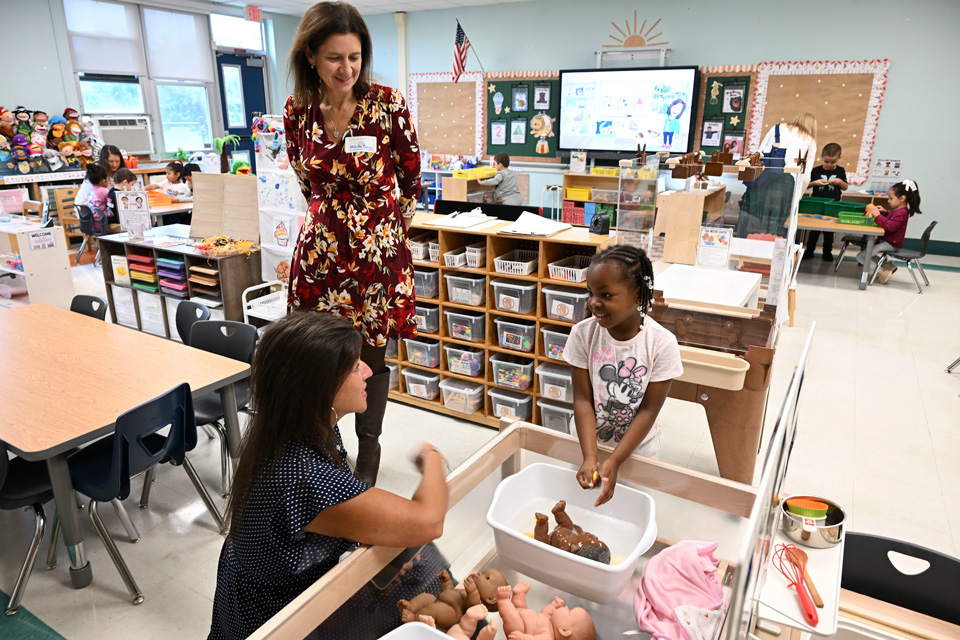 NYSUT President Melinda Person visited several pre-K classrooms in Riverhead to see its littlest learners in action. Here, she observes as Jennifer Simões, elementary intervention specialist and first vice president of the Riverhead Central Faculty Association works with one of the pre-K students.
“One of the big goals was to create units that are centered around a theme, and then to have the theme used to support language development,” said Melissa Richardson, a pre-K teacher and member of the Riverhead Central FA.
Math centers, library centers, read-alouds, and even dramatic play reinforce the chosen theme and the language that goes with it which, in turn, helps prepare students for reading in kindergarten. “So, whether we are doing ‘Me and My Family,’ or ‘Fall,’ or ‘The Farm,’ the entire classroom is centered around key vocabulary for them to be able to build their schema,” said Richardson.
“Through play, our students learn social development skills, language, problem-solving skills, independence, early academic skills, and things that are developmentally and age-appropriate and meaningful for them,” said Jennifer Barth, another pre-K teacher and member of the Riverhead Central FA.
These investments in early education are already yielding impressive returns.
“We’ve seen tremendous gains in terms of the students coming in,” said Simões. “Some of our pre-K kids even come out reading, which is incredible.”
In September, NYSUT President Melinda Person visited Riverhead to see the program in action. Person met with Simões and the pre-K team and toured the district’s pre-K classrooms.
“It is amazing how vested the entire district is in this program. The working relationship between the teachers, administration, and the Board of Education is remarkable,” said Person. “The pre-K program at Riverhead is precisely the model that we should be striving for across the state.”
Researchers have long backed the importance of early education, starting with the watershed Perry Preschool Project in 1967 that showed that preschool participants were more likely to graduate from high school, go on to college, and earn higher wages.
The Carolina Abecedarian Project in 1972 was a longitudinal study that focused on children from infancy to age 5, and found that those who participated in a full-time, high-quality early education program earned higher math and reading scores and were more likely to pursue higher education.
A recent large-scale study led by Florida International University and George Mason University went even further, showing that students who attended public school pre-K programs — as opposed to private or family-based childcare — performed better on standardized tests and earned higher grades throughout their academic careers, further underscoring the value of having highly trained teachers and strong, consistent curricula.
In spite of strong evidence and the ongoing advocacy, funding for pre-K still lags; nationally, just 37 percent of 4-year-olds and 9 percent of 3-year-olds are enrolled in state-funded pre-K, according to the National Institute for Early Education Research.
Photo Gallery
