Technology is transforming education faster than ever, but in our mad dash to adopt ever more innovative tools, have we paused to consider whether these so-called advances are truly helping our students?
In late September, NYSUT brought together more than 500 educators, parents, lawmakers, medical experts and advocates for “Unplugged,” a full day conference designed to explore the growing role of technology in our classrooms.
Attendees were invited to explore the impacts of screens and AI on learning, literacy, attention and childhood, and examine more fully what we’ve gained and what we’ve lost as a result of the breakneck expansion.
"This is not an anti-technology conference," said NYSUT President Melinda Person during her opening remarks. "Technology can be incredibly useful. It can open doors, provide access, and help educators do things that wouldn't have been imaginable a decade ago. But there's a big difference between teaching children how to use technology — or using technology as a tool — and designing education around technology. Somewhere along the way, we stopped making that distinction.”
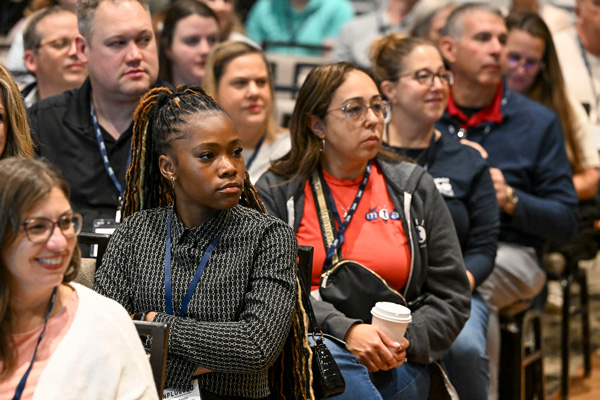 Caption: The Unplugged event brought together educators, parents, policymakers, and health professionals from across the state to weigh the risks and benefits of educational technology.
Caption: The Unplugged event brought together educators, parents, policymakers, and health professionals from across the state to weigh the risks and benefits of educational technology.
Caption: The Unplugged event brought together educators, parents, policymakers, and health professionals from across the state to weigh the risks and benefits of educational technology.
Announced in May, at a time when the debate about our excessive dependence on technology was raging in the media, the Unplugged conference seemed like it couldn’t be more timely.
The $163.5 billion global educational technology industry is projected to more than triple to $572 billion over the next decade, and AI was already its largest technology segment, comprising roughly 30 percent of its market.
Meanwhile, national and international assessments showed students’ reading and math performance declining, and a growing body of research demonstrated that enhanced access to technology was having adverse impacts on everything from students’ mental health to motor skills.
Then, at the end of summer, two tech moguls admitted that without better regulation, AI might well cause human extinction within the next 10 years, and New York City Public Schools, the largest public school system in the United States, announced a moratorium on AI in district schools and restricted screentime for all of its 845,000 students.
What once seemed like a timely conference now seemed like an urgent calling, and educators and parents came together to share their experiences and learn from each other.
“I feel like we need to make some changes for the kids because they’re really struggling,” said Rebecca Ramaglia, a special education teacher and member of the Newburgh Teachers Association. “Students’ attention spans are so much different. It’s like they’re just kind of asking you to give them the answers.”
Emily Connor, a parent and member of Schools Beyond Screens, made the trek from Dobbs Ferry to attend the conference. Connor said her family is intentionally analog, and she was surprised to learn that at school, her kindergartener was watching a Minions video to learn how to do push-ups in gym class.
“I don't know if the idea is that we have to get down on their level, just to get them to pay attention and learn?” Connor asked. “But is that even happening at such a young age? And in such basic places like gym class and music? I was just shocked.”
During the Unplugged keynote address, neuroscientist and educator Jared Cooney Horvath was blunt: digital education doesn't work.
To prove his point, Horvath showed how when states adopted digital learning, their test scores in reading and math nose-dived. “So kids are being ever more exposed to digital technology — trained on it explicitly — and they are doing worse.”
“Digital technology is there for production,” Horvath concluded. “Production is not the same as learning. It is there for experts to get work done; it’s not there for kids to learn how to become experts.”
The day’s first session brought together leaders from education and healthcare to discuss what 1-to-1 devices have done for learning. The panelists found common ground on ensuring that for kids, the vital interpersonal interactions that make school and childhood special — encouragement from a teacher while working through an assignment, a hands-on project worked on with peers, or games played with friends at recess — should always come before technology.
“It’s not about banning tech,” said Lynn Girolamo, assistant director of digital innovation at Greece Central School District. “We can’t deny the benefits of technology, but we have to keep students, teachers, and local communities at the center.”
Mary Jo Ginese, an occupational therapist and member of the United Federation of Teachers, noted that tech tools have important uses, especially for students with disabilities. “There are places where we know technology is needed,” Ginese said. “But there’s no replacement” for human relationships that guide students through their education.
During an afternoon panel, educators and public health experts debated the educational merit of AI, and whether the benefits outweigh the risks.
Panelists agreed that AI can be a useful tool for educators, helping them do more with less, streamline processes, and complete rote tasks so they have more time to spend with students; but just because teachers use it, doesn’t mean students should.
 Caption: Dobbs Ferry parent Emily Connor, a member of Schools Beyond Screens, attended Unplugged to learn more about the issue of technology in schools.
Caption: Dobbs Ferry parent Emily Connor, a member of Schools Beyond Screens, attended Unplugged to learn more about the issue of technology in schools.
Caption: Dobbs Ferry parent Emily Connor, a member of Schools Beyond Screens, attended Unplugged to learn more about the issue of technology in schools.
“I would argue that we are not ready for artificial intelligence in our schools,” said Kaliris Salas-Ramirez, a parent, president of Community Education Council 4 and associate professor at the Robert Wood Johnson Medical School. “We are trying to teach young people how to learn, be problem solvers, be critical thinkers, be innovators, and be healers and leaders in this moment.”
Lucy Collins, assistant professor of philosophy at the Fashion Institute of Technology, said inherent design features in AI make it unsuitable for students.
“You know the minute you ask the question, it quickly says, ‘Are you ready for me to write the draft?’ ‘Do you want me to write the draft?’” Collins said. “If I can’t resist that at times and if a college student cannot resist that, then how are we asking a 13-year-old to resist that?” said Collins. “Given the design that we have right now, I’m not sure that there is a responsible use in this current moment.”
Educators and lawmakers also explored how to develop effective policy around tech use in schools, the next logical step after the child protection laws like the recent SAFE for Kids Act, NY Child Data Protection Act, social media warning label legislation, and last year’s phone-free schools policy.
“This conversation is front and center in the Legislature,” said New York State Senator Shelley Mayer. “There's great concern in our conference, and I think among many parents, that there is too much technology in schools, and that the money that we as the Legislature killed to get — full funding of the Foundation Aid formula — too much of that is being spent on technology as opposed to the human interaction with teachers and counselors and other staff.”
The majority of panelists shied away from moratoriums, like the one adopted downstate, in favor of more regulation of ed tech accompanied by the implementation of age-appropriate screentime restrictions.
State lawmakers, including state Sen. Andrew Gounardes, have proposed bills for the coming legislative session aimed at reining in the ed tech industry's influence and placing limits around both screens and AI use in classrooms.
“Children’s brains are developing and growing,” said James McDonald, commissioner of New York’s Department of Health. “Kids need to be introduced to technology in a way that correlates with their development.”
“I hope that you would never give your 4-year-old a jigsaw,” McDonald said. “When you put your 4-year-old in front of an iPad, I have so many questions.”
Throughout the day, panelists reinforced the need for educators to have input in tech decisions, including what is being used and how, and demanded an end to top-down digital decision-making.
“EdTech has a stranglehold on my association and on every principals’ association. If you go to their conferences, it's all about tech, tech, tech, and now, AI, AI,” said Greg Taranto, superintendent for Canon-McMillan School District in PA. “So, your superintendent comes back and what they think is, ‘We have to get iReady because I went out for dinner with an iReady rep, and they said this really works.’”
During the closing conversation, Person talked to educators from Croton-Harmon Schools, who, in the wake of COVID, were charged with the task of re-examining how they use technology and determine when it was in the best interest of students, and when it was just technology for technology’s sake.
“We were collaborating with the teachers in our buildings consistently, and that's what really moved the needle on the change,” said Laura Dubak, Croton-Harmon superintendent.
For many, the biggest takeaway was that teachers should be at the center of digital decision-making.
“We have to trust the professionals in the room who spend the time with the students all day, every day, to know what's appropriate for those students,” said Ron Roaldsen, technology coach for East Williston Union Free School District and president of the East Williston Teachers Association. “And I think when we do that, we'll probably see less screen time.”
Photo Gallery